What is the zero article (Nullartikel)?
The zero article simply means that no article (der, die, das, ein...) appears before the noun.
Instead of:
- der gute Wein
- ein gutes Buch
you simply have:
- guter Wein
- gutes Buch
Without an article, the adjective itself must carry the grammatical information.
This is called strong adjective declension (starke Deklination).
Why do the adjective endings change?
Normally, the article already tells us the gender, case, and number.
Example:
der alte Mann
Here der already tells us:
- masculine
- singular
- nominative
Therefore the adjective only needs the weak ending:
"alte"
Without an article:
"alter Mann"
Now nothing indicates masculine nominative except the adjective.
Therefore it receives the strong ending:
"alter"
When is the zero article used?
The zero article commonly appears in several situations.
Uncountable nouns
frisches Wasser
kalte Milch
heißer Kaffee
Plural nouns in general statements
interessante Bücher
gute Freunde
moderne Autos
Materials
hochwertiges Holz
deutscher Stahl
feine Seide
Abstract nouns
großer Erfolg
starke Motivation
tiefe Hoffnung
Professions or descriptions
erfahrener Arzt
kompetente Mitarbeiter
The strong adjective endings
When no article appears, adjectives usually take the following endings:
Masculine
| Case | Ending | Example |
|---|---|---|
| Nominative | -er | guter Wein |
| Accusative | -en | guten Wein |
| Dative | -em | gutem Wein |
| Genitive | -en | guten Weines |
Feminine
| Case | Ending | Example |
|---|---|---|
| Nominative | -e | gute Milch |
| Accusative | -e | gute Milch |
| Dative | -er | guter Milch |
| Genitive | -er | guter Milch |
Neuter
| Case | Ending | Example |
|---|---|---|
| Nominative | -es | gutes Bier |
| Accusative | -es | gutes Bier |
| Dative | -em | gutem Bier |
| Genitive | -en | guten Bieres |
Plural
| Case | Ending | Example |
|---|---|---|
| Nominative | -e | gute Freunde |
| Accusative | -e | gute Freunde |
| Dative | -en | guten Freunden |
| Genitive | -er | guter Freunde |
Strong vs. weak adjective declension
The easiest way to remember the difference is:
No article → strong adjective ending
Compare:
| With article | Without article |
|---|---|
| der alte Mann | alter Mann |
| das kleine Haus | kleines Haus |
| die schöne Stadt | schöne Stadt |
| ein guter Wein | guter Wein |
The article normally carries the grammatical information. Without it, the adjective must do the job.
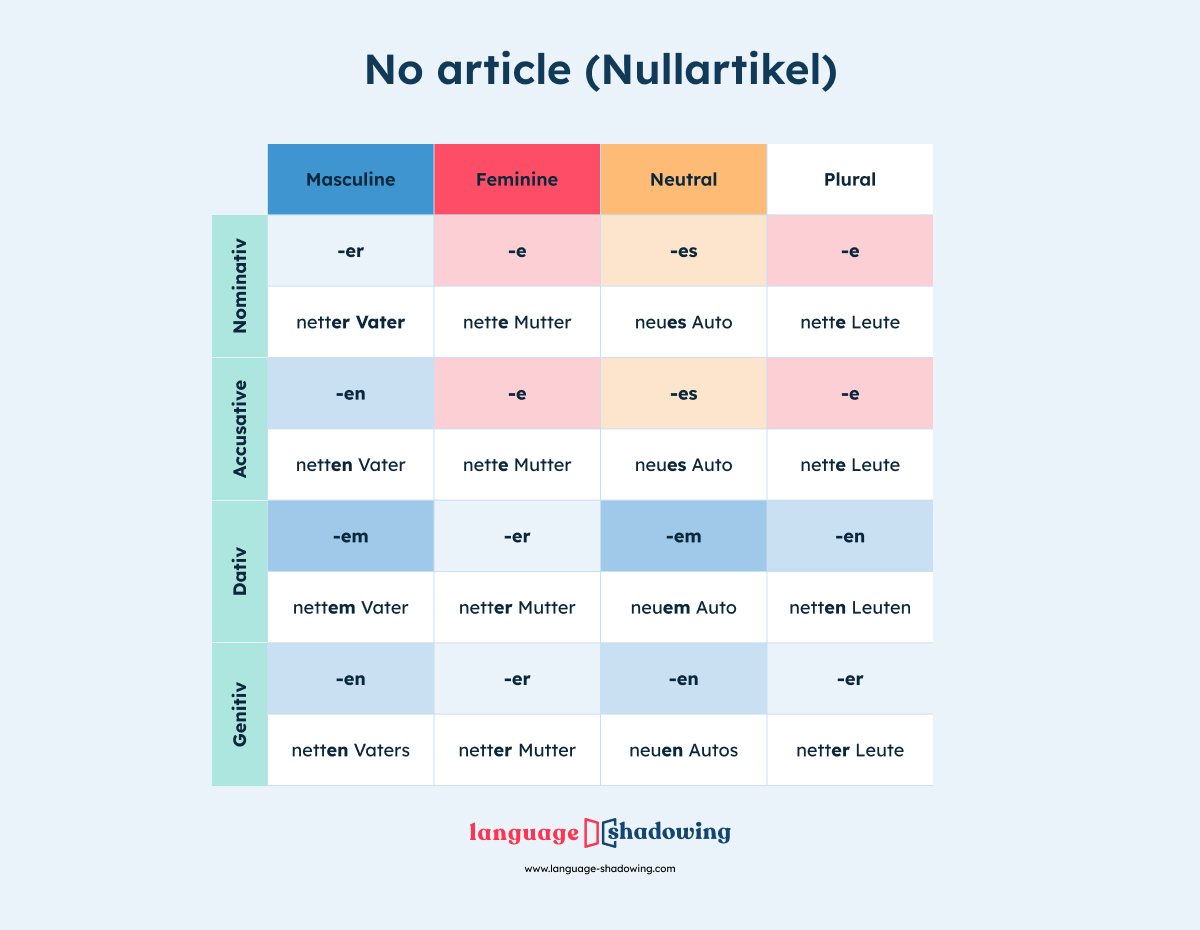
Information flow
The zero article is most often used when speaking about things in general rather than one specific person or object.
Pattern:
General category → adjective carries the grammar
Example:
Frische Lebensmittel enthalten viele Vitamine.
The speaker is referring to fresh food in general, not one particular item.
Typical B2 examples
This structure appears constantly in formal German.
Academic writing
Frische Forschung liefert neue Erkenntnisse.
Fresh research provides new insights.
Business German
Internationale Unternehmen investieren zunehmend in nachhaltige Technologien.
International companies are increasingly investing in sustainable technologies.
Newspapers
Steigende Energiepreise belasten viele Haushalte.
Rising energy prices are burdening many households.
Formal reports
Effektive Kommunikation verbessert die Zusammenarbeit.
Effective communication improves cooperation.
Scientific language
Genetische Faktoren beeinflussen zahlreiche Krankheiten.
Genetic factors influence numerous diseases.
Why is this common at B2?
The zero article is especially useful when making general statements.
Instead of referring to one specific object, German often speaks about an entire category.
Examples
- Neue Technologien verändern unseren Alltag.
- Internationale Zusammenarbeit gewinnt an Bedeutung.
- Gesunde Ernährung verbessert die Lebensqualität.
- Regelmäßige Bewegung stärkt das Immunsystem.
Such sentences are common in essays, presentations, newspaper articles, reports, and Goethe B2 speaking and writing tasks.
Zero article vs. definite article
Both structures describe nouns, but they express different meanings.
With the definite article, the speaker refers to a specific person or thing.
→ Der rote Wagen gehört meinem Nachbarn.
With the zero article, the speaker refers to things in general.
→ Rote Wagen sind derzeit besonders beliebt.
Zero article vs. indefinite article
These constructions also differ in meaning.
The indefinite article introduces one unspecified object.
→ Ein interessantes Buch liegt auf dem Tisch.
The zero article usually refers to a whole category or to uncountable nouns.
→ Interessante Bücher erweitern den Horizont.
Common mistakes
Learners often forget that without an article, the adjective must carry the grammatical ending.
Wrong adjective ending:
❌ guter Freunde
✔ gute Freunde
Wrong ending with feminine nouns:
❌ gutes Milch
✔ gute Milch
Wrong dative plural:
❌ gutem Bücher
✔ guten Büchern
Wrong neuter nominative:
❌ alter Haus
✔ altes Haus
Adding an unnecessary article:
❌ der frisches Wasser
✔ frisches Wasser
B2 exam tip
Use the zero article whenever you make general statements about people, objects, ideas, materials, professions, or plural nouns.
Before choosing the adjective ending, ask yourself:
Is there an article before the noun?
If the answer is no, the adjective will usually need the strong declension.
Mastering this pattern will make your German sound considerably more natural and formal, especially in essays, reports, newspaper summaries, presentations, and Goethe or telc B2 exams.
Practice This Grammar Rule Interactively:
Practice translation exercises with automatic correction, improve your grammar actively, and even generate your own personalized language learning videos.
Follow Us on Facebook
Want more German learning tips, grammar explanations, shadowing videos, vocabulary practice, and updates about new lessons?
Follow Language Shadowing on Facebook and become part of our growing community of German learners.
We regularly share new grammar lessons, pronunciation tips, interactive exercises, and learning strategies to help you build fluency naturally through listening, repetition, and active practice.