What does "Vorzeitigkeit in der Vergangenheit" mean?
Literally:
- Vorzeitigkeit = something happened earlier
- Vergangenheit = the past
So:
Vorzeitigkeit in der Vergangenheit = an action happened before another action in the past.
In English, this is usually expressed with "had + past participle" (the past perfect).
The Basic Idea
Imagine two events in the past:
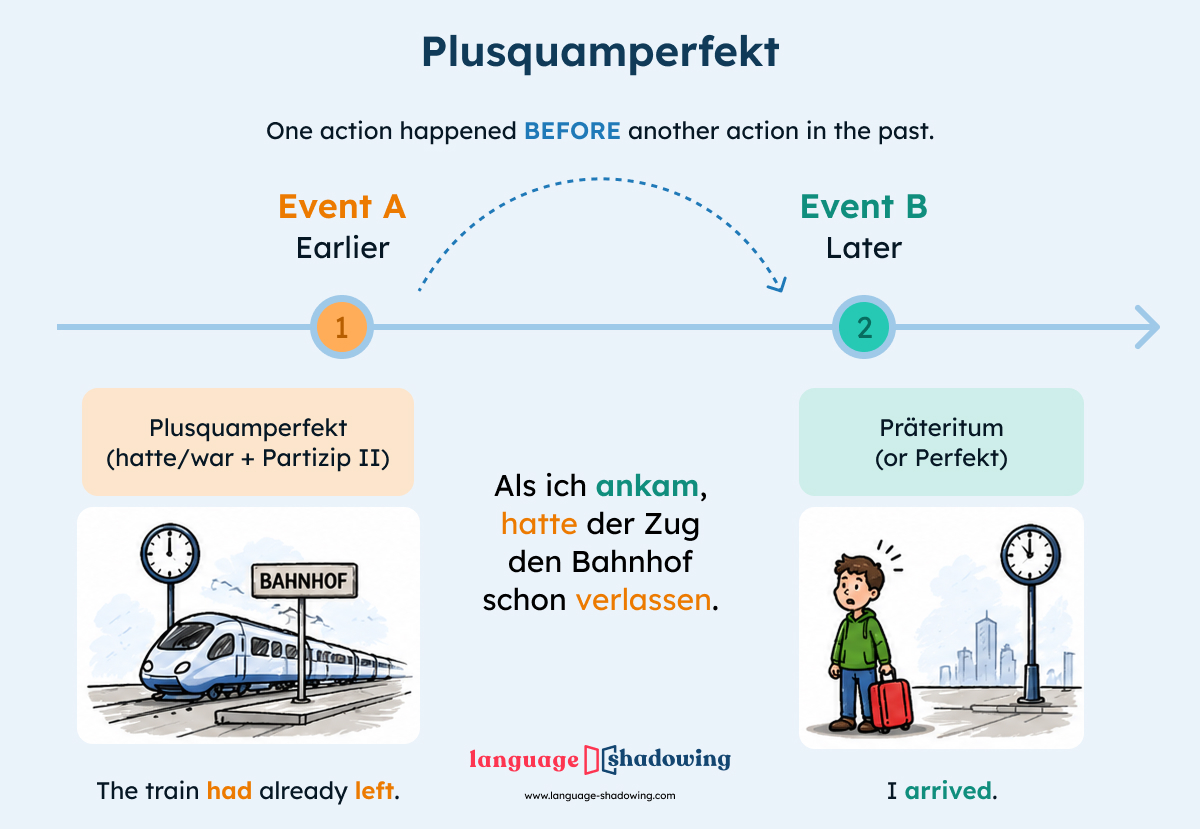
The earlier event is in Plusquamperfekt.
The later event is usually in Präteritum (or sometimes Perfekt).
Example 1
Als ich ankam, hatte der Zug den Bahnhof schon verlassen.
Translation:
When I arrived, the train had already left the station.
Timeline:
1. The train left.
2. I arrived.
The train leaving happened first, so it is in the Plusquamperfekt:
hatte verlassen
Example 2
Nachdem ich gefrühstückt hatte, ging ich zur Arbeit.
Translation:
After I had eaten breakfast, I went to work.
Timeline:
1. Breakfast
2. Going to work
The earlier action uses Plusquamperfekt.
Why Not Use Perfekt?
Compare:
Perfekt
Ich habe gefrühstückt.
I ate / I have eaten.
Just a past action.
Plusquamperfekt
Ich hatte gefrühstückt, bevor ich zur Arbeit ging.
I had eaten breakfast before I went to work.
Now we clearly show that one action happened before another past action.
Formation
With haben-verbs
hatte + Partizip II
| Infinitive | Plusquamperfekt |
|---|---|
| machen | hatte gemacht |
| sehen | hatte gesehen |
| kaufen | hatte gekauft |
Examples:
- Ich hatte gearbeitet.
- Sie hatte gelernt.
- Wir hatten gegessen.
With sein-verbs
war + Partizip II
| Infinitive | Plusquamperfekt |
|---|---|
| gehen | war gegangen |
| kommen | war gekommen |
| fahren | war gefahren |
Examples:
- Ich war gegangen.
- Sie war angekommen.
- Wir waren gefahren.
Common Signal Words
These often indicate that one action happened before another:
bevor (before)
Bevor wir losfuhren, hatten wir getankt.
Before we left, we had filled up the car.
nachdem (after)
Nachdem sie gegessen hatte, ging sie spazieren.
After she had eaten, she went for a walk.
als (when)
Als ich nach Hause kam, war mein Bruder schon eingeschlafen.
When I came home, my brother had already fallen asleep.
schon (already)
Er hatte das Buch schon gelesen.
He had already read the book.
Word Order with "nachdem" and "bevor"
nachdem
Nachdem ich meine Hausaufgaben gemacht hatte, sah ich fern.
Notice:
- Partizip II → gemacht
- Auxiliary → hatte
Both go to the end of the subordinate clause.
bevor
Bevor wir gingen, hatten wir gegessen.
Before we left, we had eaten.
Typical B1 Story Example
Letztes Jahr hatte ich einen Urlaub in Berlin geplant. Als ich am Bahnhof ankam, war mein Zug schon abgefahren. Deshalb musste ich einen späteren Zug nehmen.
Translation:
Last year I had planned a holiday in Berlin. When I arrived at the station, my train had already departed. Therefore, I had to take a later train.
Notice how the Plusquamperfekt provides background information about what had happened before the main events of the story.
B1 Exam Strategy
When writing or speaking:
Ask yourself:
"Am I talking about two past actions?"
If yes:
"Which one happened first?"
The first action → Plusquamperfekt
The second action → Präteritum (usually in written German) or Perfekt (often in spoken German).
Example
Ich hatte meine Schlüssel vergessen, deshalb konnte ich die Tür nicht öffnen.
Translation:
I had forgotten my keys, therefore I could not open the door.
The forgetting happened first, so it uses Plusquamperfekt.
Quick Formula
Earlier past action
- hatte + Partizip II
- war + Partizip II
Later past action
- usually Präteritum or Perfekt
Example
Als ich im Kino ankam, hatte der Film schon begonnen.
= When I arrived at the cinema, the movie had already started.
This is exactly what "Vorzeitigkeit in der Vergangenheit" means: using the Plusquamperfekt to show that one event happened before another event in the past.
Practice This Grammar Rule Interactively:
👉 https://app.language-shadowing.com/#tab=translation/DE-B1-0005
Practice translation exercises with automatic correction, improve your grammar actively, and even generate your own personalized language learning videos.